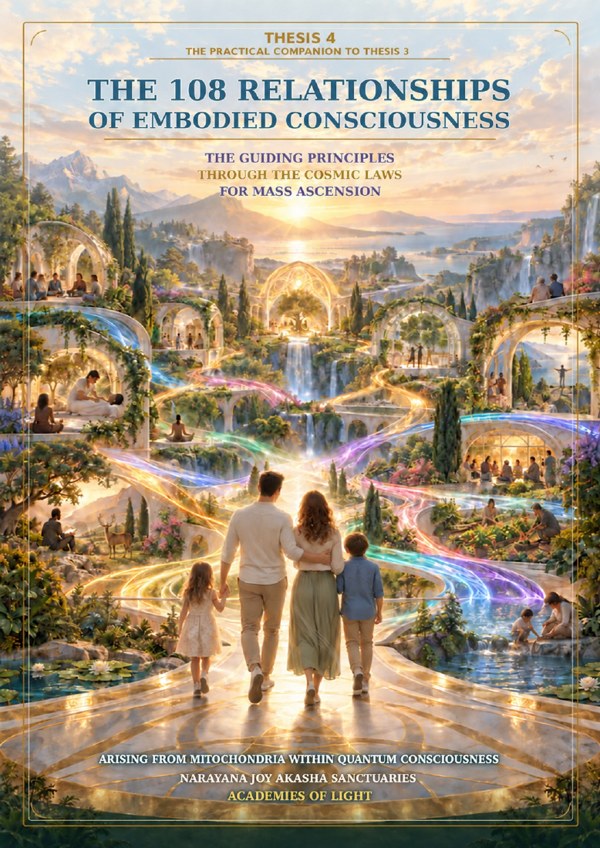
The 108 Relationships of Embodied Consciousness — The Educational Guide
a living educational guide for the practical application of the Nine Cosmic Laws, arising from Thesis 3, module by module.
Platinum Edition, 25 October 2026 · 360 pages · Free PDF · Print edition ISBN 978-1-0667307-3-5
The Educational Guide exists because an architecture, however precisely drawn, does not by itself tell a person how to stand inside the building it describes. Thesis Three names a Wheel of 108 Relationships in which the Twelve Fields of Translation, moving from quantum potential to embodied awareness, meet the Twelve Human Approaches through the Nine Cosmic Laws. That naming is necessary, but it is not yet practice. The 108 Relationships of Embodied Consciousness — the full study programme this page introduces — receives the same twelve Fields and nine Laws not as a further structure to be admired from a distance, but as a hundred and eight distinct meetings through which a reader can observe how consciousness is already attempting to become biologically, relationally and ethically true in an ordinary day. The movement from Thesis into Guide has been likened, within the Guide's own pages, to the difference between the drawing of a building and the first human footfall across its floor: the proportions remain essential, but the reason for the structure only discloses itself once breath, conversation, tiredness, grief, celebration and service begin to inhabit it.
Each of the Twelve Modules corresponds to one of the Fields already named on this site's Thesis Three page — Quantum Potential and Receptive Presence, Electron Flow and Right Exchange, Proton Gradient and Conscious Containment, Cellular Transmutation and Surrendered Transformation, ATP Vitality and Available Service, Calcium Intelligence and Responsive Timing, Oxidative Signalling and Measured Intensity, Membrane Coherence and Relational Boundary, Neuronal Synchrony and Shared Attunement, Adaptive Memory and Compassionate Remembrance, Organismal Resonance and Whole-Field Listening, and Embodied Awareness and Consecrated Participation. Within each Module, all Nine Cosmic Laws are met in turn, so that a single Field — Quantum Potential, say — is examined nine times over: once through Chemical Affinity, once through Vital Affinity, and onward through the Lost Octave, Magnetic Consciousness, Proportionate Ascension, Coherent Renewal, Remembered Being, Feminine Totality and Masculine Totality. Twelve Fields multiplied by nine Laws gives the Guide its full span: 108 Relationships, each carrying a permanent reference identity — M01 R001 opens Quantum Potential through Chemical Affinity, and M12 R108 closes Embodied Awareness through Masculine Totality — so that a reader, study circle or facilitator can always locate a particular chamber of the work regardless of edition or pagination.
The Guide sets out a considered sequence for that inward movement — Attention, Orientation, Understanding, Relationship, Practice, Recognition, Integration and Service — and is careful to say that this is not a ladder of achievement. Attention simply notices what is present; Orientation locates it within the wider field; Understanding perceives the relationships contributing to it; Practice offers one voluntary way of meeting it; Recognition receives what the practice reveals; Integration allows that recognition to enter the body and daily life; and Service permits whatever has been gathered to become available beyond the self. The same sequence, the Guide observes, can unfold within a single breath or across many years, and its educational value lies precisely in preserving movement without demanding haste.
Because the programme can be entered in more than one way, a reader is never required to master mitochondrial biology or metaphysical language before beginning. The Plain-Language Doorway that opens the study proper invites a person to start instead from whatever is actually present — tiredness, uncertainty, conflict, an unclear boundary, an old memory, a question of timing — and a Situation Finder then points toward the Module whose human approach speaks most directly to it: conscious containment for a mind that feels flooded, available service grounded in real energy for depletion or burnout, a relational boundary that protects rather than punishes for difficulty saying no, receptive presence for uncertainty before an important choice, right exchange for a one-sided relationship, surrendered transformation for an identity or arrangement that no longer fits, responsive timing for acting too soon or too late, truth carried at a receivable intensity for conflict that overwhelms dialogue, shared attunement for feeling unheard, compassionate remembrance for an old protective reaction shaping the present, and whole-field listening wherever a group decision has left someone unheard. Every one of these doorways returns, in the end, through four human thresholds the Guide names explicitly: the body and its breath, energy and felt sense of safety; the interior life of emotion, memory and belief; relationship, with its speech, silence, consent and repair; and participation, where a recognition becomes visible in family, work, community, Sanctuary or wider service. None of these thresholds is treated as infallible on its own — a strong bodily sensation may call for medical attention rather than metaphysical interpretation, and a group resonance may still conceal pressure the Guide asks its readers to notice rather than override.
The full Thesis, with its Wheels, is also presented on the Narayana Joy Akasha Sanctuaries website.
This introduction, with chapters and subtitles, is part of The Thesis Series on our YouTube channel: all ten Theses, each gently introduced in conversation.
▶ Watch Thesis 4 on YouTube Listen · The Full Podcast (41 min) Read · The Full ThesisA research thesis of the Narayana Joy Akasha Sanctuaries, offered free as a PDF, with a short video overview and the full podcast.